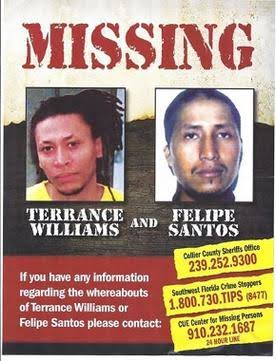
There's something particularly unsettling about a missing persons case where the last known contact is a police officer. That's exactly what happened twice in Naples, Florida, three months apart, to two men who had nothing in common except the bad luck of crossing paths with the same deputy.
Felipe Santos disappeared in October 2003. Terrance Williams disappeared in January 2004. Both were last seen getting into the patrol car of Collier County Sheriff's deputy Steven Calkins. Neither has been found since. No one has ever been charged. Their families are still waiting, more than twenty years on, and honestly, so is everyone else who's followed this case.
What Happened to Felipe Santos
It started with something almost mundane. On October 14, 2003, 23-year-old Felipe Santos was driving to work with his two brothers when their car was involved in a minor accident — the kind of fender-bender that normally gets sorted out and forgotten. Santos, who'd come to the U.S. from Mexico and was living undocumented in nearby Immokalee, tried to handle it quietly with the other driver. No police, no paperwork. The other driver wasn't having it, though, and called it in.
Corporal Steven Calkins showed up to take the report. He cited Santos for reckless driving and driving without a license, put him in the back of the patrol car, and left the scene.
That should have been the end of a bad morning. Instead, it was the last anyone heard from him.
When Santos's brother and his boss went to bail him out of jail later that day, there was no record he'd ever been booked. He wasn't there. He wasn't anywhere, as far as anyone could tell.
Calkins's explanation, when investigators eventually asked, was that he'd changed his mind on the way to the station. Rather than book Santos, he said, he'd dropped him at a Circle K about a mile from the accident and watched him walk off toward the pay phones. That was it, according to Calkins — last he ever saw of him.
The family didn't buy it for a second. But there wasn't much they could do. Letting someone go instead of arresting them isn't against department policy, so an internal review cleared Calkins and the file got closed.
Santos was gone. He left behind a fiancée and a baby daughter in Naples, plus family back in Oaxaca who would later pull the Mexican Consulate into the search for answers that, to this day, nobody has.
Then It Happened Again
Barely a month after Calkins was formally cleared in the Santos case, it happened again — and this time there were witnesses.
On January 12, 2004, 27-year-old Terrance Williams was pulled over by Calkins near 111th Avenue North and Vanderbilt Drive in North Naples. The official reason was that his white Cadillac looked like it was having engine trouble. Williams didn't have his license or registration on him.
When he didn't turn up that evening, his mother, Marcia Williams, didn't wait around. She started calling everywhere herself — jails, hospitals, morgues, psychiatric units. Nothing. Then she got resourceful and started phoning tow yards around town, and that's how she found his Cadillac sitting at Coastland Towing. It had been hauled out of Naples Memorial Gardens cemetery. The tow slip had Steven Calkins's signature on it.
That's when things got strange. The Sheriff's Office had no arrest report, no booking, nothing on file for Williams that day. But cemetery employees told a different story entirely — they'd watched the whole thing happen. They said Calkins pulled Williams over right there on the cemetery grounds, asked for ID he didn't have, patted him down, and put him in the back of the cruiser. Before driving off, he asked if it'd be alright to leave the Cadillac parked in their lot. He came back anywhere from fifteen minutes to an hour later, by different accounts, and moved the car out into the road — where it then got towed for blocking traffic. The keys were just sitting on the ground beside it.
Calkins's Story Started Falling Apart
At first, when detectives reached out to ask about Williams, Calkins said he simply couldn't remember stopping anyone or towing any cars that day. Funny thing — a few days later, once his supervisors told him he needed to file a formal report, his memory came back in surprising detail.
According to that report, Calkins first spotted Williams's Cadillac around 12:15 in the afternoon, driving erratically. Williams supposedly told him he was running late for work and asked for a lift to a nearby Circle K, so Calkins drove him over and dropped him off. Later, Calkins said, he went back to check the car and noticed the registration wasn't where Williams had told him it would be. Feeling like he'd been played, he claimed he called the Circle K to track Williams down — and was told nobody by that name worked there.
Piece by piece, none of it held up.
The cemetery workers had put the actual stop at 9 or 10 in the morning, which lines up with the fact that Williams's shift was supposed to start at 10 — not the 12:15 p.m. timeline Calkins gave. Phone records showed no call from his department cell to that Circle K, ever. Surveillance video from the store didn't show either man setting foot inside. The employees there had no memory of a Terrance Williams working a shift, let alone one who'd vanished. And somehow, Calkins knew a fake birthdate that Williams used to give police when he got pulled over — information he shouldn't have had access to if he genuinely hadn't run a background check until after he says he'd already let Williams go.
By the time internal affairs was done digging, they'd counted roughly two dozen places where Calkins's own statements contradicted each other or just didn't match the evidence. He lost his job over it. But losing a job isn't the same as facing charges, and despite everything investigators found, there's never been enough physical evidence to charge him with anything.
A Coincidence That's Hard to Swallow
Here's the thing that makes this case sit differently than a typical disappearance: Santos was Latino. Williams was Black. Calkins is white. Both men were stopped for essentially the same minor traffic violation, three months apart, by the same officer, in the same stretch of Naples — and both vanished completely the moment they got into his car.
Doug Molloy, the assistant U.S. attorney who headed up a multi-agency task force looking into both disappearances as potential hate crimes, didn't mince words about what he came to believe: "It is my belief that they were killed because of their color."
Nobody has ever found a body. No physical evidence has surfaced linking Calkins to a crime. The theory most investigators and the journalists who've spent years on this lean toward is that Calkins killed both men, likely during or right after he picked them up — but a theory is all it's been able to stay, because without remains or a confession, there's nowhere left for the case to go on its own.
The Case That Wouldn't Stay Buried
For a long stretch, this stayed a local story — the kind of thing Naples residents knew about but that never traveled much further. That changed in 2018, when the families, working with civil rights attorney Ben Crump, filed a wrongful death lawsuit against Calkins. Crump wasn't shy about what he thought happened, telling reporters at the press conference: "This lawsuit is going to formally say what people have been informally saying, and that is that he intentionally murdered Terrance Williams and Felipe Santos."
Around the same time, Tyler Perry got involved after hearing about the case through an episode of the Investigation Discovery series Disappeared. He put up a $100,000 reward for any information that could lead to finding the men or charging someone — and later doubled it to $200,000. Civil rights leaders Al Sharpton and Ben Jealous lent their voices too, helping keep the story from fading again.
Then in 2023, it reached a much bigger audience through The Last Ride, an eight-part investigative podcast from journalists at the Naples Daily News and USA Today Network Florida, paired with a sprawling CNN investigation that dug back through Calkins's record and picked apart every inconsistency in his story.
Marcia Williams has kept telling her son's story in the years since, including an interview marking the 20th anniversary of his disappearance — still searching, still without the answer she's been waiting two decades for.
Where Things Stand Now
Both cases are still technically open. The Collier County Sheriff's Office still has Terrance Williams and Felipe Santos listed as missing and endangered, and over the years the FBI, the U.S. Attorney's Office, the Florida Department of Law Enforcement, and the State Attorney's Office have all taken a turn looking into it. The CUE Center for Missing Persons has kept up awareness efforts for both men as well.
As for Steven Calkins — no criminal charges, ever. He's maintained his innocence the whole way through.
If you know anything about what happened to Terrance Williams or Felipe Santos, the Collier County Sheriff's Office and the National Center for Missing & Exploited Persons both want to hear from you.
Sources
Disappearances of Terrance Williams and Felipe Santos — Wikipedia
The Naples, Florida, deputy and the disappearances of Terrance Williams and Felipe Santos — CNN
Two missing men, one deputy, zero charged — NPR
Tyler Perry helping to find justice for the families of two missing men — Tyler Perry