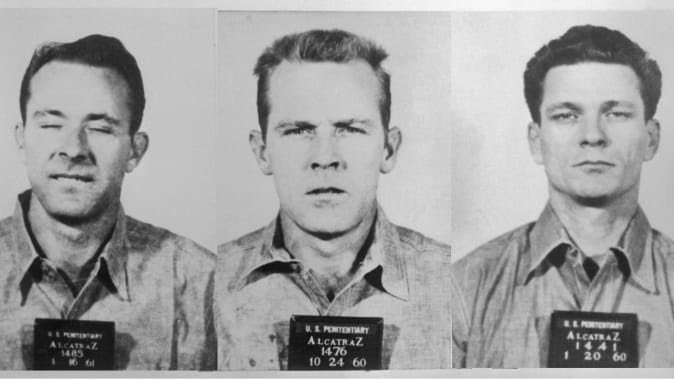
The prison was supposed to be inescapable. On June 11, 1962, three men proved otherwise — and whether they survived it remains an open question more than 60 years later.
Frank Morris and brothers John and Clarence Anglin escaped from Alcatraz Federal Penitentiary in San Francisco Bay on the night of June 11, 1962. Whether they made it to shore alive, or drowned trying, has never been definitively resolved.
A Fortress in the Bay
Alcatraz's reputation rested largely on its location: a rocky island surrounded by the cold, fast-moving waters of San Francisco Bay, considered enough of a deterrent on its own that no full escape had ever succeeded. Morris, Clarence, and John had all served time together in previous prisons before ending up in adjoining cells at Alcatraz, where they began planning their escape with a fourth inmate, Allen West.
Six Months of Preparation
The men spent roughly six months quietly enlarging ventilation openings behind their cells using tools improvised from spoons and other scavenged materials, eventually creating passages large enough to climb through to an unguarded utility corridor and up to the roof. They built papier-mâché dummy heads, using real hair and flesh-toned paint, convincing enough to fool night guards during routine bed checks. West, who had helped plan much of the operation, was unable to free his own cell opening in time and was left behind when the other three made their move on the night of June 11.
Into the Water
Morris and the Anglin brothers made it to the roof, down the side of the building, and into the bay aboard a makeshift raft and life vests constructed from more than 50 stolen prison raincoats. What happened after that has never been confirmed. Fragments of the raft were later found, suggesting it may have come apart at some point during the crossing.
The Official Conclusion
The FBI investigated for 17 years before officially closing its case in 1979, concluding that the men most likely drowned in the bay's frigid, fast currents, based on circumstantial evidence and expert opinion. No bodies were ever recovered. Responsibility for the case passed to the U.S. Marshals Service, which has kept it formally open and active ever since — the men remain on an active wanted list that isn't set to expire until 2026 through 2031, when they would have turned 100.
Decades of Leads That Never Quite Confirm It
Over the years, the case has generated a steady stream of leads that have never been conclusively verified. A family friend claimed to have photographed John and Clarence in Brazil in 1975, standing near termite mounds; analysts hired by the Anglin family and by researchers behind a 2024 book concluded the photo was a strong facial match, while government analysts have remained unconvinced. In 2013, San Francisco police received a letter claiming to be from John Anglin, stating all three men survived and asking for leniency in exchange for turning himself in; FBI handwriting and forensic analysis was ultimately inconclusive. Family members have also described receiving unexplained gifts and correspondence in the years after the escape, none of which has ever been independently verified as coming from the men themselves.
Where Things Stand Now
The U.S. Marshals Service released updated age-progression images of what the three men might look like in their 90s, continuing to treat the case as a live, if unlikely, manhunt. Deputy marshals assigned to the case have said publicly they still receive tips regularly. Whether Morris and the Anglin brothers died in the bay that night or built new lives elsewhere remains, six decades later, genuinely unresolved.
Frequently Asked Questions
Is the Alcatraz escape case still open?
Yes. The U.S. Marshals Service maintains it as an active case, with the men remaining on a wanted list set to expire between 2026 and 2031.
Has any body ever been found?
No. Despite an extensive search at the time and in the years since, no remains have ever been recovered.
Is there real evidence they survived?
The evidence remains disputed. A 1975 photo claimed to show the Anglin brothers in Brazil, and a 2013 letter claimed to be from John Anglin, but neither has been officially confirmed as authentic.