Most killers want to get in and get out. This one stayed for hours — used the family's computer, ate their food, took a nap on their couch — and walked out into the morning without leaving a name behind. A quarter century later, Japan still doesn't have one.
A Quiet Family, a Quiet Neighborhood
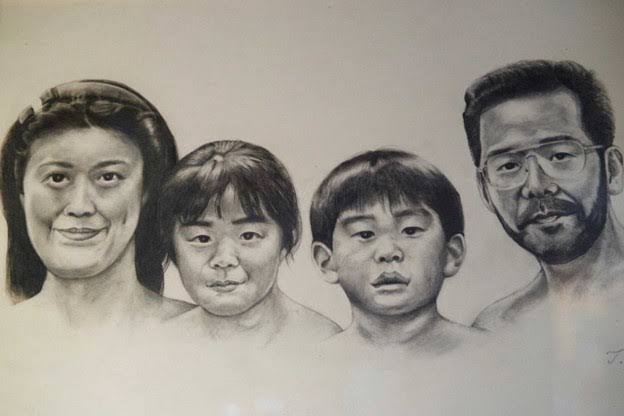
On the evening of December 30, 2000, the Miyazawa family was settling in for the holiday. Mikio, 44, worked in marketing and was online for part of the evening. His wife, Yasuko, 41, watched television with their 8-year-old daughter, Niina. Their 6-year-old son, Rei, was upstairs on his own.
They lived in Kamisoshigaya, a residential pocket of Setagaya — one of Tokyo's largest wards, but a section of it that felt more like a quiet suburb than part of one of the busiest cities on earth. Yasuko's mother lived right next door.
The next morning, December 31, that proximity is what led to the discovery. When repeated phone calls to her daughter's house went unanswered, Yasuko's mother let herself in. She found Mikio's body first, then Yasuko's, then Niina's. Rei, the youngest, was found dead in his bed.
What the Crime Scene Revealed
Investigators determined the killer had entered through an upstairs window after cutting the home's phone lines. Mikio appeared to have been the first attacked — he'd opened a password-protected work email at 10:38 p.m. that night, giving police their best estimate for when the attack began. He was found stabbed near the staircase. Yasuko and Niina were found upstairs, also stabbed, with wounds investigators described as notably more severe than Mikio's — a detail that led some investigators toward an early theory involving misogyny as part of the killer's motive. Rei, alone in his room, had been strangled rather than stabbed; police believe he may have been the first victim killed, before the others were even aware anything was wrong.
What happened after the killings is, in some ways, the strangest part of the entire case. The killer didn't flee. He stayed in the house for hours — by some estimates as long as ten — eating food from the family's kitchen, including melon and ice cream, drinking their barley tea, using their bathroom without flushing, browsing bookmarked websites on their computer, and at one point apparently napping on the couch. He rifled through drawers, dumping some contents in the bath and toilet, took a small amount of money, and left behind an unusually complete pile of his own belongings on his way out before dawn: a knife, a scarf, a hip bag, a sweater, gloves, a hat, shoes, and handkerchiefs.
An Overwhelming Amount of Evidence, and No Name to Attach It To
This is, by most measures, one of the most heavily investigated unsolved cases in Japanese history. More than 246,000 investigators have been involved at various points. Over 12,500 individual pieces of evidence have been logged. As of recent reporting, dozens of officers were still assigned to the case full-time decades after the murders — a level of sustained resourcing almost unheard of for a case this old.
DNA recovered from the scene — blood likely from a wound the killer sustained during the attack — indicated the perpetrator was male, with Type A blood, and very likely of mixed heritage: maternal DNA pointing toward European ancestry, with more recent analysis narrowing this further to the Caucasus region, while paternal DNA markers were shared with a notable percentage of Korean, Chinese, and Japanese men. Investigators have used this profile to seek assistance from Interpol, on the theory the killer might not currently be in Japan at all, or might never have had a permanent presence there.
Other physical clues have proven harder to interpret than expected. Fecal matter left at the scene contained traces of sesame seeds and string beans, leading some investigators toward theories about the killer's home life. Clothing recovered from the scene had apparently been laundered using mineral-heavy hard water, a detail consistent with washing practices more common in South Korea than Japan — fueling years of speculation about the killer's origin, though it has never been confirmed as definitive.
Police have repeatedly revised their estimate of the killer's age over the years. Early profiles suggested a young man, possibly a teenager. More recent analysis, as of 2025, has pushed that estimate up to someone likely in his thirties at the time of the murders — a meaningful shift that's reframed parts of the original investigation entirely.
A Long List of Theories, None Confirmed
Several competing theories have circulated for years, none of them proven:
In the weeks before the murders, Mikio had reportedly clashed with local teenagers using a nearby skate park, and separately with members of a local motorcycle gang who frequented the same area — leading some investigators to wonder about a grudge-driven attack by someone young and local.
Japan's large American military presence has also fueled speculation, given the killer's apparent mixed heritage and a long, difficult history of crimes committed by U.S. servicemen stationed in the country — though there's no direct evidence tying the case to anyone connected to the military.
A Japanese true crime writer, publishing under a pen name, released a book in 2015 claiming to have identified the killer as a former South Korean military member he referred to only as "R," allegedly motivated by the Miyazawa family's refusal to sell their land amid a local redevelopment push. Police investigated the claims and found the evidence insufficient to substantiate them; the theory has also drawn criticism for what some see as an underlying bias against Korean nationals, with no confirmed link ever established.
Investigators have also openly entertained the idea that the killer was driven by personal hatred, sexual motivation, or simple economic desperation during Japan's prolonged "Lost Decade" economic stagnation — though robbery itself has been all but ruled out, given how little was actually taken and how much time the killer spent in the house afterward, seemingly unconcerned with being caught.
A Case That Refuses to Fade
Public memory of the case has been kept deliberately alive. Each December, police return to the Miyazawa house for a memorial, and they've continued handing out flyers and displaying a mannequin dressed in clothing matching the killer's description at a nearby train station, hoping someone, somewhere, will finally recognize something. A reward of 20 million yen remains on offer for information leading to an arrest. Takeshi Tsuchida, the retired police official who once led the local station and has stayed connected to the case for decades, has continued attending the family's grave on the anniversary, calling the case's lack of resolution one of the defining regrets of his career.
In May 2026, the house itself made news again — not because of a break in the murder case, but because two men were arrested for breaking into the now-vacant property, apparently unaware of its history. It was a strange, almost unbearably mundane footnote to a case that has otherwise resisted any kind of resolution for a quarter century.
The case has had one lasting legal consequence beyond its own walls: public outrage and sustained attention on the Setagaya murders became part of the push that led Japan to abolish its statute of limitations on crimes punishable by death, a change enacted in 2010 specifically so cases like this one could never simply expire.
The Miyazawa family's grave is still visited by relatives every year. The investigation, as of the most recent reporting, remains open.
Sources
Setagaya family murder — Wikipedia https://en.wikipedia.org/wiki/Setagaya_family_murder
Police continue searching for killer of Setagaya family 25 years on — The Japan Times https://www.japantimes.co.jp/news/2025/12/30/japan/crime-legal/setagaya-murder-search/
Setagaya family murders remain unsolved after 25 years — Japan Today https://japantoday.com/category/crime/Setagaya-family-murders-remain-unsolved-after-25-years
Why Japan's notorious Setagaya murders still haunt police and public, 25 years on — South China Morning Post https://www.scmp.com/week-asia/people/article/3338345/why-japans-notorious-setagaya-murders-still-haunt-police-and-public-25-years
UNSOLVED: The Murder of the Miyazawa Family — The Lineup https://the-line-up.com/the-murder-of-the-miyazawa-family
The Setagaya Family Murder Case — Tokyo Weekender https://www.tokyoweekender.com/art_and_culture/history/the-setagaya-family-murder-case/
Two arrested for allegedly entering site of high-profile Setagaya family murder — The Japan Times https://www.japantimes.co.jp/news/2026/05/14/japan/crime-legal/setagaya-murder-site-enter-arrest/