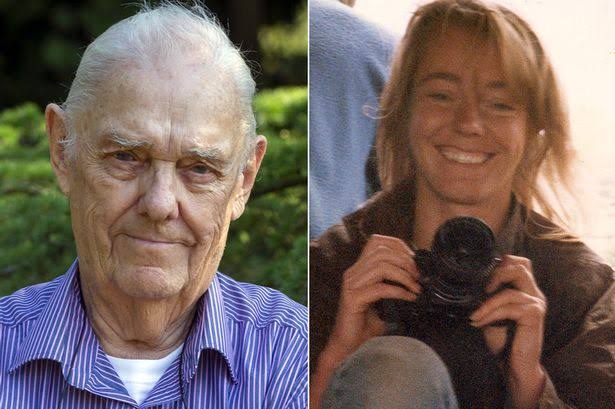
He found his daughter's leg first, lying near a burned-out fire in the grass. Over the next thirty-five years, he would make more than a hundred trips back to that country, refusing to accept the explanations he was given. He died still searching.
A Trip of a Lifetime
Julie Ward was 28, a publishing assistant from Bury St Edmunds, England, with a passion for wildlife photography. In February 1988, she set off for a seven-month trip to Kenya, planning to capture the country's wildlife before returning home. In early September, with her trip nearly finished, she headed into the Masai Mara game reserve with an Australian friend, Dr. Glen Burns, hoping to photograph the annual wildebeest migration.
Their vehicle broke down on September 5. Burns returned to Nairobi for repairs while Julie stayed the night alone at a nearby lodge. The next day, September 6, she drove back to collect her camping equipment from a nearby site. It was the last confirmed sighting of her alive.
A Father's Search
When Julie failed to return to Nairobi as planned, her father, John Ward, flew to Kenya himself. He hired a small plane to search the areas of the reserve where she'd been known to camp, and a pilot eventually spotted her abandoned vehicle in a gully near a river. John went to investigate in person.
On September 13, 1988, he found her remains — burned, dismembered, scattered near the site of a fire — among the ashes himself. Additional remains, including her skull and jawbone, were found a month later near the Kenya-Tanzania border.
An Investigation Built on Denial
Kenyan authorities initially offered explanations that strained credibility from the start: that Julie had been struck by lightning, or attacked and eaten by lions or hyenas. Neither explanation accounted for the fact that her remains showed clear signs of dismemberment by a sharp blade, not animal predation, and had also been burned.
John Ward refused to accept the official account and began his own investigation. A British pathologist who examined the case concluded Julie had been dismembered with a machete, doused in fuel, and set on fire — findings starkly at odds with Kenya's original coroner's report, which had been altered to obscure the evidence of a blade. In October 1989, a Kenyan inquest finally ruled that Julie had been murdered, not killed by accident or wildlife.
Decades of Trials, No Convictions
John Ward persuaded the UK's Foreign Secretary to involve Scotland Yard in the investigation, and detectives traveled to Kenya in 1990. Two junior park rangers were eventually charged and went on trial in 1992; both were acquitted for lack of evidence, with the presiding judge recommending that the head park ranger himself be investigated.
In 1997, a new team of Kenyan police reopened the case. In July 1998, Simon Ole Makallah, the chief park warden at the time of Julie's death, was arrested after a two-year investigation. He went on trial in 1999 and was acquitted that September, again for lack of sufficient evidence.
Throughout these proceedings, John Ward accused both the Kenyan and British governments of obstructing the investigation, alleging that Kenya's tourism industry interests played a role in how reluctant authorities were to pursue the case seriously. A former British intelligence officer later acknowledged having some involvement in the case, while denying any role in an actual cover-up.
A Suspicion That Was Never Resolved
John Ward came to believe that Jonathan Moi, son of then-Kenyan President Daniel arap Moi, was responsible for his daughter's death — a serious and politically explosive allegation that, given the family's position at the time, would help explain decades of resistance to a thorough investigation if true. No charges were ever brought against Jonathan Moi, and the allegation has never been proven in court. It remained, throughout John Ward's life, his own strongly held belief rather than a legally established fact.
In 2004, a British inquest held in Ipswich formally recorded a verdict of unlawful killing. In 2009, the case was reopened once more after a private visit to Kenya by John Yates, then head of London's Metropolitan Police anti-terrorism unit, who believed advances in DNA technology might finally identify a suspect. That same year, a key witness in the case, Valentine Ohuru Kodipo — who had lived in exile in Denmark for two decades out of fear connected to his testimony — died before the renewed investigation could make use of his account. DNA samples recovered from the crime scene were tested in 2011, but the effort produced no new leads.
In 2018, John Ward continued publicly campaigning for Kenyan authorities to obtain a DNA sample from the man he'd long suspected, in hopes of finally testing his theory against physical evidence. That request, too, went unanswered.
A Search That Outlasted His Own Life
John Ward spent close to £2 million of his own money on the investigation over more than three decades and made over a hundred trips to Kenya, refusing at every stage to let the case fade quietly away. He published a book, The Animals Are Innocent: The Search for Julie's Killers, in 1991, and had reportedly completed a second manuscript shortly before his death.
John Ward died in 2023, just short of his 90th birthday — only two weeks after his wife, Jan, Julie's mother, had also passed away. Friends and journalists who knew him over the decades described his determination as remarkable, sustained not by any realistic expectation of a quick resolution, but by a refusal to let his daughter's case simply be forgotten or filed away unresolved.
A Case That's Never Closed
Julie Ward's murder remains formally unsolved. Three people were charged with it over the years; none was ever convicted. As of the most recent reporting, there have been reports that a multi-part dramatization of the case is in development for streaming release, which would bring renewed public attention to a story that, even after John Ward's death, his surviving family has continued to want told accurately.
More than thirty-five years after Julie Ward's death, the question her father spent the rest of his life trying to answer — who killed his daughter, and why it took so long for anyone in authority to take that question seriously — remains, officially, unanswered.
Sources
Killing of Julie Ward — Wikipedia
https://en.wikipedia.org/wiki/Killing_of_Julie_Ward
Breaking News: death of John Ward, the father of murdered Julie Ward — The Kenya Forum
https://www.kenyaforum.net/columnists/breaking-news-death-of-john-ward-father-of-murdered-julie-ward/
They Said She Was Eaten By Lions — But The Real Story Of Her Disappearance Is More Grim — All That's Interesting
https://allthatsinteresting.com/julie-ward
Julie Ward: A father's 23-year search for justice — Daily Nation
https://nation.africa/kenya/life-and-style/dn2/julie-ward-a-father-s-23-year-search-for-justice--788540