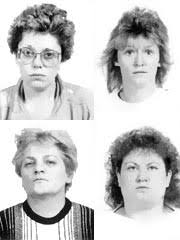
A doctor overheard them bragging in a bar about their latest kill. That overheard conversation is the only reason the killing ever stopped.
Four Women, One Night Shift
Between 1983 and 1989, four women working as nurse's aides at the Geriatriezentrum am Wienerwald, a hospital in the Lainz district of Vienna, Austria, murdered dozens of elderly patients under their care. Waltraud Wagner, then in her early twenties, was the first — and went on to recruit three colleagues from the same night shift: Maria Gruber, Irene Leidolf, and Stephanija Mayer, a Yugoslav immigrant roughly twenty years their senior, who became something of a senior figure within the group.
According to the account reconstructed by investigators, Wagner's first killing began, in a grim way, as a response to a patient's own suffering — a 77-year-old woman in severe distress reportedly asked her for help ending it, and Wagner administered a fatal morphine overdose. What followed wasn't a single act of mercy. Wagner later described discovering, in that moment, that she enjoyed the sense of control over who lived and who didn't — and the killings continued, expanding well beyond any claimed mercy motive, for the next six years.
A Pattern That Was Difficult to Detect
We're not going to detail the specific methods the group used beyond what's necessary to understand why the case went undetected for so long. Their methods evolved over time from medication overdoses to a technique that produced symptoms difficult to distinguish from natural causes in elderly patients, particularly those already prone to fluid buildup in the lungs — a detail that made their crimes especially hard for hospital staff to recognize as anything other than the ordinary, sad reality of geriatric care.
Investigators later criticized the hospital itself for responding with what one inquiry described as "a wall of silence" when a 1988 death first drew suspicion. The killing only stopped after a doctor overheard members of the group discussing one of their killings at a local tavern and reported it.
A Confession That Shrank Under Scrutiny
When questioned, the women initially admitted to a far higher number of deaths than they were ultimately convicted of — at one point claiming responsibility for up to 49 deaths, with at least one member of the group telling Vienna's health department she believed their actual total was closer to 100. As the case moved toward trial, several of the women began walking back their earlier admissions, and by the time proceedings began in March 1991, much of the original confession had been retracted or minimized.
Austria's then-chancellor, Franz Vranitzky, was unmoved by the retractions, publicly calling it the most brutal crime spree in the country's history.
Conviction and Sentencing
Prosecutors couldn't make all of the original 42 counts of murder stick, but secured convictions on a substantial number of them. In March 1991, Waltraud Wagner was convicted of 15 murders, 17 attempted murders, and two counts of aggravated assault, and sentenced to life in prison. Irene Leidolf was also given a life sentence, convicted on five counts of murder. Stephanija Mayer received 20 years and Maria Gruber 15 years, both on manslaughter and attempted murder charges, reflecting their somewhat lesser roles within the group.
Free Again, Years Later
Austria does not have a death penalty, and in practice, even a "life" sentence there has historically translated to a finite term rather than true lifelong imprisonment. Stephanija Mayer and Maria Gruber, who'd received the shorter sentences, were released years before the other two, both reportedly given new identities to start over.
Waltraud Wagner and Irene Leidolf remained imprisoned considerably longer — nearly two decades — before Austria's Justice Ministry announced in 2008 that both would be released on conditional, good-behavior grounds. The announcement drew real public unease in Austria at the time, arriving in the same year the country was already reckoning with the Josef Fritzl case, and many Austrians publicly questioned whether the country's approach to its most serious offenders was genuinely adequate. As one Vienna resident put it to reporters at the time, it felt deeply unfair to victims' families that women convicted of this scale of killing could still look forward to decades of free life afterward.
Where Things Stand
As of the most recent reporting, all four women have been free for years, with no public indication of further criminal activity since their respective releases. The case remains one of the most significant institutional murder cases in modern European history — not only for the scale of the killing itself, but for what it revealed about how easily sustained abuse can go undetected in a setting built around the expectation that elderly, vulnerable patients will sometimes die quietly, and where the staff entrusted with their care are rarely suspected of being the actual cause.
Sources
Lainz Angels of Death — Wikipedia
https://en.wikipedia.org/wiki/Lainz_Angels_of_Death
Austria's "Angels Of Death" To Be Released — CBS News
https://www.cbsnews.com/news/austrias-angels-of-death-to-be-released/
Serial Killer Waltraud Wagner — The Lainz Angels of Death — Serial Killer Calendar
https://www.serialkillercalendar.com/Waltraud%20WAGNER.php