He ruled over millions of people and never once set foot in the country he owned.
King Leopold II of Belgium privately owned the Congo Free State as his personal property from 1885 to 1908. During his rule, historians estimate that millions of Congolese died under a brutal system of forced labor, and the atrocities committed there remain one of the darkest chapters of European colonialism.
A Private Colony
The Congo Free State was established following the 1885 Berlin Conference, where European powers divided up African territory largely without any African representation at the table. Unlike other colonies, the Congo wasn't governed by the Belgian state — it belonged personally to Leopold II, who administered it entirely from Belgium and never visited.
The Rubber Quota System
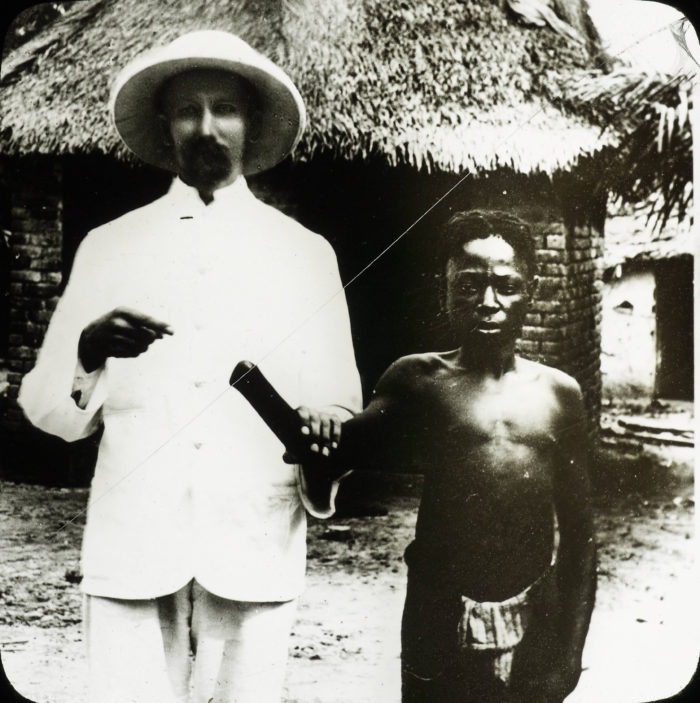
As global demand for rubber surged, companies operating under Leopold's authority, including the Anglo-Belgian India Rubber Company, imposed strict rubber-collection quotas on Congolese villages, buying rubber for a fraction of what it sold for in Europe. Villages that failed to meet their quotas faced brutal punishment: colonial militias were known to sever the hands of workers, and sometimes their children, as proof to superiors that ammunition hadn't been "wasted." Villages that resisted entirely could be burned, and forced labor, starvation, and disease killed enormous numbers of people across the territory.
A Photograph That Shocked the World
Among the most widely known images from this period is a photograph, taken around 1904 by missionary Alice Seeley Harris, of a Congolese man named Nsala looking at the severed hand and foot of his young daughter, killed by colonial militia after her village failed to meet its rubber quota. Harris's photographs, distributed by British and American reformers, became instrumental in exposing the scale of the violence to an international audience that had largely been unaware of what was happening.
International Pressure and the End of Leopold's Rule
Growing international outrage, driven by missionaries, journalists, and reform campaigners such as E.D. Morel and Roger Casement, eventually forced Leopold to relinquish personal control of the territory. In 1908, the Congo Free State was annexed by the Belgian government and became the Belgian Congo, a colony that remained under Belgian rule until Congo's independence in 1960. Historians estimate that up to 10 million people died during Leopold's 23-year rule, though the exact toll can never be fully known.
Belgium's Modern Reckoning
Belgium was slow to publicly confront this history, and the subject wasn't extensively taught in Belgian schools for decades. That began to shift following the 2020 Black Lives Matter protests, when demonstrators vandalized several statues of Leopold II across the country. That June, King Philippe of Belgium — a distant descendant of Leopold II — became the first member of the royal family to express formal regret, writing to Congo's president that "violent and cruel acts were committed which continue to weigh down on our collective memory." In 2022, during his first visit to Congo, Philippe reiterated his "deepest regrets" in person. Belgium's parliament has since launched a formal commission to examine the colonial period, and the country has begun returning looted Congolese artifacts.
Philippe has stopped short of a formal apology or any commitment to reparations, a distinction that has drawn criticism from Congolese officials and activists who argue that regret alone doesn't address the material legacy of what happened. The question of whether Belgium should issue a full apology, and whether reparations are owed, remains an active and unresolved debate in both countries.
Frequently Asked Questions
How many people died under Leopold II's rule of the Congo?
Historians commonly estimate up to 10 million deaths from violence, forced labor, starvation, and disease, though an exact figure isn't possible to confirm.
Did Leopold II ever visit the Congo?
No. He ruled the territory entirely from Belgium and never set foot there.
Has Belgium ever formally apologized for these atrocities?
Not formally. King Philippe has expressed "deepest regrets" on multiple occasions since 2020, but neither he nor the Belgian government has issued a formal apology or committed to reparations.