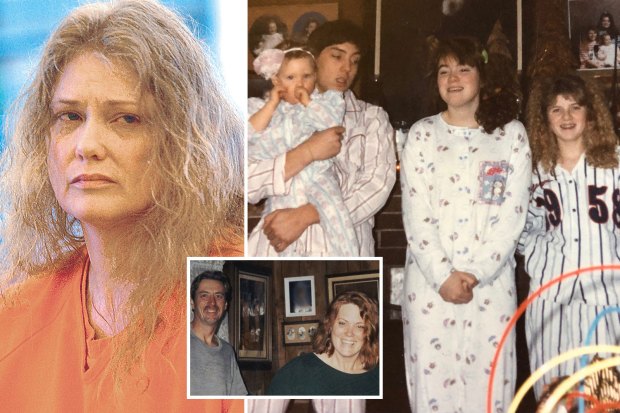
Three sisters grew up calling her "mom." It took them most of their childhood, and the courage to walk into a police station as adults, to call her something else.
Michelle "Shelly" Knotek and her husband, David, ran what looked from the outside like an ordinary, generous household in rural Raymond, Washington — the kind of family that took in struggling relatives and friends who had nowhere else to go. For more than a decade, that generosity hid something far darker. In 2003, Shelly and David's own adult daughters went to the police. What followed was one of the more disturbing domestic abuse and murder cases to come out of the Pacific Northwest.
A Marriage Built on Control
David Knotek met Shelly in 1982, a Navy veteran working construction who, by his own account, thought she was the most striking woman he'd ever met. Shelly was a young, twice-divorced mother of two daughters, Sami and Nikki, at the time. The couple married in 1987 and had a third daughter, Tori, two years later. From the outside, they looked like a normal, happy family.
According to one of the daughters, David simply wasn't built to stand up to Shelly. "I love him," she's said, "but Dave is a very feeble man. That's why my mother was able to dominate him." Whatever the dynamic between them, the abuse in that house didn't stay contained to David. It extended to all three girls — and it extended even further to the people the family took in.
The People Who Came to Stay
In 1988, Shelly's nephew, Shane Watson, moved in with the family. His mother struggled with addiction; his father was frequently incarcerated. He was meant to find stability with his aunt and uncle. Instead, according to his cousins, he found a household where punishment was constant and arbitrary — confinement, exposure to cold and wet conditions overnight, and forced humiliation were treated as ordinary discipline.
A family friend named Kathy Loreno moved in around the same time, after losing her job. For a while, Shelly showered her with warmth and attention. That didn't last. Over the years that followed, Loreno's health and independence deteriorated under conditions in the home that included isolation, deprivation, and physical mistreatment — by the time she'd lived there for six years, she'd lost a significant amount of weight and was largely confined to the basement.
In 1994, according to David Knotek's later account, Loreno died after years of this treatment. Rather than report her death or seek any kind of medical or legal accounting, David and Shelly burned her body in their backyard and scattered the remains in the Pacific Ocean.
The First Death Leads to a Second
For a while, the secret held. Then, in February 1995, Shane approached one of his cousins, Nikki, with photographs he'd taken documenting Loreno's condition before she died — evidence, he told her, that he intended to bring to the police.
Nikki, young and frightened, told her mother instead.
What happened next is almost impossible to soften: Shelly directed David to kill Shane in the family's backyard. He did. The body was disposed of the same way Loreno's had been.
Here's the thing that makes this case sit differently than most: it wasn't a single act of violence in a moment of rage. It was a pattern, sustained over years, in which abuse was followed by overwhelming displays of affection — building a kind of psychological hold over the entire household that made speaking up feel impossible.
A Third Victim, and a Breaking Point
By 1999, Sami and Nikki were adults and had moved out, leaving only the youngest daughter, Tori, still living at home. That same year, Ron Woodworth — a 57-year-old veteran who was gay and had struggled with substance abuse — came to stay with the family while David was away working a job more than a hundred miles from home.
Woodworth was welcomed at first, the same way Shane and Kathy had been. The treatment that followed was severe, prolonged, and ultimately fatal. By August 2003, Woodworth had died from his injuries. Shelly kept his body in a freezer for four days before David returned home.
That same week, Sami, Nikki, and Tori were together at Nikki's home in Seattle. Whatever finally tipped the balance, the three sisters made the decision none of them had been able to make alone for years: they went to the police.
What the Courts Decided
David Knotek was ultimately convicted in connection with Shane Watson's death and the disposal of Kathy Loreno's remains. Shelly faced charges tied to the deaths of Ron Woodworth and Kathy Loreno.
Nearly everyone involved accepted plea agreements. Shelly took a different path — an Alford plea, a legal arrangement that allowed her to formally accept a guilty conviction while continuing to maintain her own innocence. It meant the full case never had to be laid out in front of a jury.
David was sentenced to 15 years and was released on parole in 2016. He later reached out to his daughters to ask for forgiveness; Sami and Tori have said they've forgiven him, viewing him as another of Shelly's victims. Nikki has not been able to do the same.
Shelly was sentenced to roughly 22 years. She was released from the Washington Corrections Center for Women on November 8, 2022, after serving about 19 years with credit for good behavior. Her release drew significant backlash in the small community of Raymond, where residents were never told exactly where she would be living — only that she was barred from returning to Pacific County. Her daughters had publicly warned years earlier, in 2019, that they believed she remained dangerous, calling her a "ticking time bomb."
Where Things Stand Now
As of the most recent public reporting, Shelly Knotek has not been connected to any further criminal activity since her release, though she remains under court-ordered supervision. Her relationship with her daughters remains distant. No remains were ever directly tied to a fourth disappearance — Loreno, Watson, and Woodworth's deaths are the three confirmed within the case — and the full picture of what happened inside that house over more than a decade has only ever fully surfaced through the daughters' own testimony, much of which was later detailed in journalist Gregg Olsen's book on the case, If You Tell.
Three sisters spent their childhoods inside that house. It was the three of them, together, who finally ended it.
Sources
Meet Shelly Knotek, The Serial Killer Mom So Vicious Her Own Daughters Turned Her In — All That's Interesting https://allthatsinteresting.com/shelly-knotek
Is Shelly Knotek Still in Prison? Her Arrest & Its Aftermath — Shortform Books https://www.shortform.com/blog/is-shelly-knotek-still-in-prison/
'Evil is out and amongst us': Outrage as serial killer Shelly Knotek released from prison after serving sentence — MEAWW https://meaww.com/evil-is-out-and-amongst-us-outrage-as-serial-killer-shelly-knotek-released-from-prison
Michelle Knotek — Grokipedia https://grokipedia.com/page/Michelle_Knotek